Volcanos represent nature at its most primordial form, providing raw, visual spectacles and, at times, cataclysmic danger. For many, fascination outweighs risk — travelers journey to (literal) hot spots all around the world to get up close to rumbling, or sometimes sleeping, giants.
Volcano eruptions are also notorious for halting travel. Since early May, the ongoing eruption of Kilauea in Hawaii Volcanoes National Park, which remains closed, has destroyed neighborhoods and limited tourism due to sporadic earthquakes, lava flows and acid rain laden with sulfur dioxide.
For the undeterred, here’s a guide on how to safely visit a few of the best destinations for volcano tourism.
Haleakala National Park, Maui, Hawaii
If there’s anywhere on the planet that’s synonymous with volcanoes, it’s Hawaii — the entire chain of islands was created as a stationary magma hot spot bulged through a moving tectonic plate. For example, on the Big Island itself, there are five volcanoes: the extinct Kohala; the dormant Mauna Kea; and Hualalai, Mauna Loa and Kilauea, which are all active.
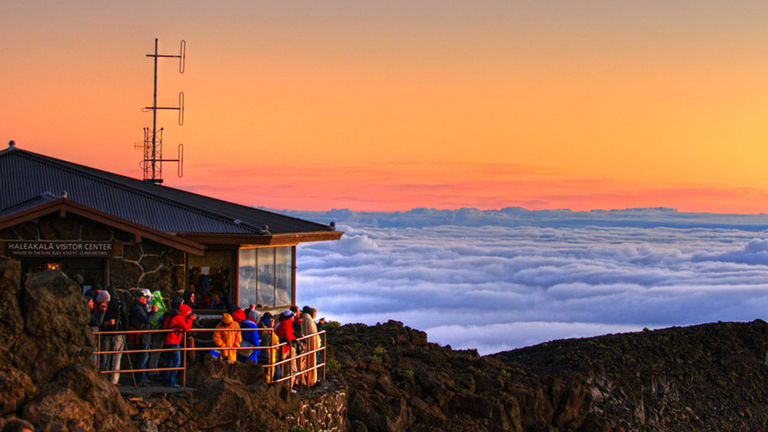 A small fee and reservations will grant visitors early access to Haleakala National Park to witness awe-inspiring sunrises.
Credit: 2018 Creative Commons user lwtt93As an alternative to Hawaii Volcanoes National Park, Maui’s Haleakala National Park is beautiful place to admire rich colors of a rugged volcanic landscape, especially in its summit region. Hiking trails weave across the massive, dormant shield volcano. However, the area is remote, so be prepared with adequate clothing, food and water, as well as common sense.
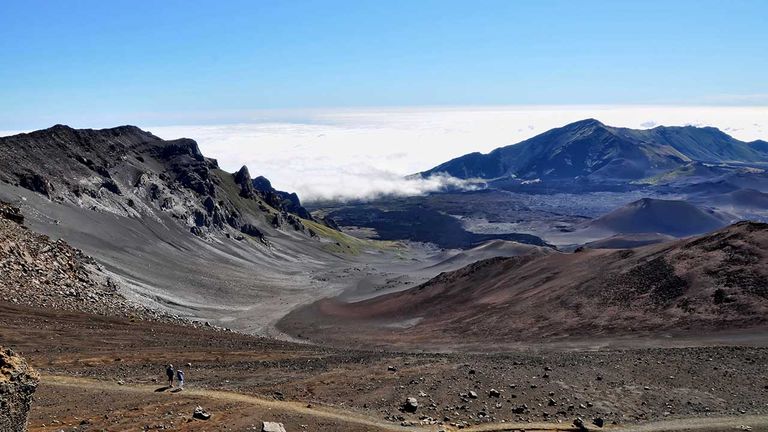 Hikers can explore the rugged beauty of Haleakala’s summit region.
Credit: 2018 Creative Commons user ruggybearThe endangered nene, or Hawaiian goose, can also be seen on the national park’s slopes. Certainly, the most popular activity is watching the sunrise from Haleakala’s various overlooks. Because of the high demand, online reservations and a small fee are now mandatory, on top of the initial park entrance costs. But, the vista from Red Hill at 10,023 feet elevation is undoubtedly worth it.
www.nps.gov
Thrihnukagigur, Iceland
For how frosty the climate can be in Iceland, the island nation straddles the geologically violent Mid-Atlantic Ridge and can certainly turn up the heat in a big way (see sidebar). Though the fireworks and dramatic plumes of ash are more obvious reasons to visit a volcano, travelers can experience a different type of excitement at Thrihnukagigur, a dormant peak just 9 miles outside of Reykjavik.
There, tour operator Inside the Volcano has constructed a cable car system that takes customers down into a richly colorful, and thankfully empty, magma chamber that’s large enough to fit the iconic, 244-foot-high Hallgrimskirkja (Iceland’s tallest church).
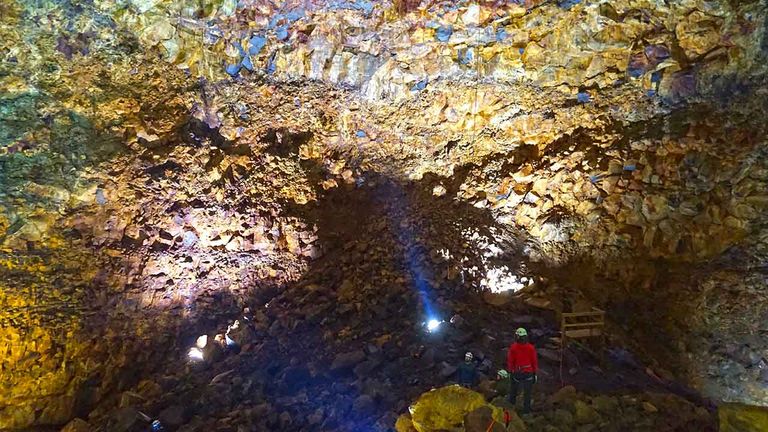 The colorful innards of Thrihnukagigur’s magma chamber are so vast, the entire Statue of Liberty could fit inside.
Credit: 2018 Creative Commons user darrenmercerThe price per person is about $40, all gear is provided, and they provide hotel pickup and drop-off, but clients will have to make a moderate 2-mile hike to the crater rim. It’s worth the effort.
www.insidethevolcano.com
Travel Warning
Despite extensive scientific monitoring, volcanoes are, at their core, unstoppable and can be a wrench in travel plans around the world.
In 2010, the notorious eruption of Iceland’s glacier-crusted Eyjafjallajokull ejected 330 million cubic yards of ash more than 5 miles into the atmosphere, grounding planes across 20 countries and affecting 10 million travelers. When clients choose to vacation close to volcanoes, safety should always be discussed.
Let them know the risks and realities: Following an eruption, flight delays are likely, so clients may have to alter their departure airport. The key is to stay flexible and communicate with airlines. Oftentimes, public transportation can get travelers out of the danger zone, such as during the 2017 explosion of Mount Agung in Bali.
Damp shirts can be used to filter out ash in extreme cases. Low-lying areas and rivers can be particularly threatening due to mudslides and should be avoided. Review travel insurance policies as some don’t cover eruptions.
Stromboli, Italy
Known historically by the Romans as the “Lighthouse of the Mediterranean,” Stromboli is a member of the Aeolian Islands and has been volatile since ancient times. Civilization has clung to its feet for thousands of years, and today, visitors can stroll through charming Italian villages framed by the looming form on the horizon.
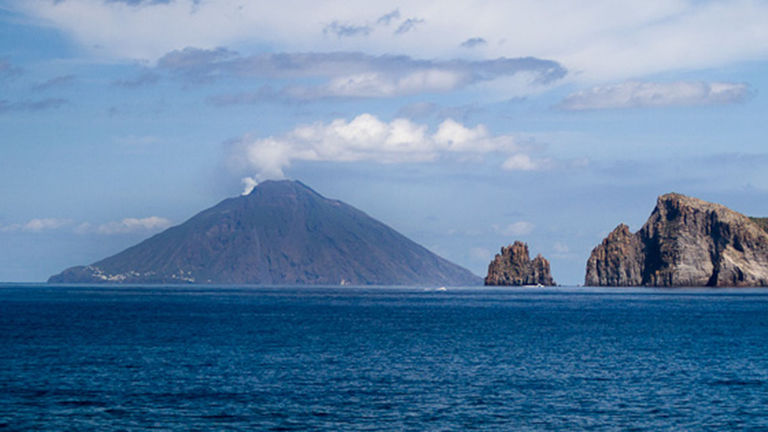 Stromboli rises sharply from the sea and at night creates stunning displays as lava shoots down its face.
Credit: 2018 Creative Commons user darthaleExpeditions up the slopes to the crater are permitted only with an official guide, and space is limited. However, travelers can get an even better view while on a boat tour, especially at night. Once the sun sets, ribbons of lava illuminate the sides of the mountain like red bolts of lightning stuck in time.
Mount Aso, Japan
Japan accounts for 10 percent of the world’s volcanic activity, and the most expansive caldera in the country is Mount Aso, a cluster of five volcanoes in the middle of Kyushu. Some say the formation looks like a sleeping Buddha on the horizon, with smoke coming out of the bellybutton.
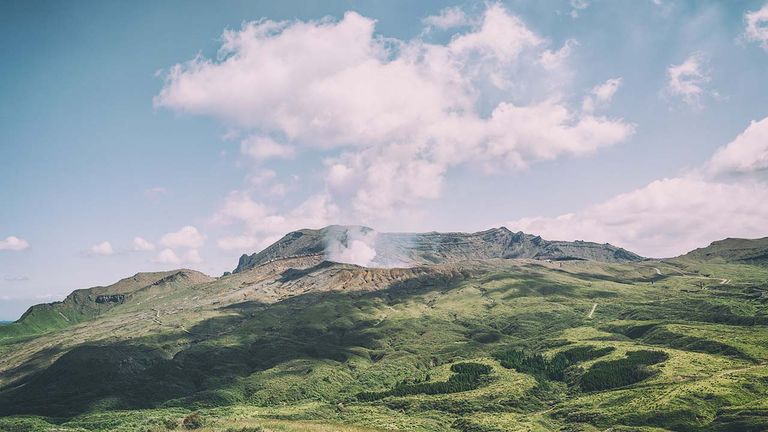 Mount Aso rises from the grassy central plateau on Japan’s southwest island Kyushu.
Credit: 2018 Creative Commons user hillbererNakadake, the main crater, has a steaming, turquoise lake that can be reached by a toll road or an aerial tram. Sometimes the visitors’ center is closed off when poisonous gases emissions increase, so be sure to check conditions ahead of time.
Rotorua and Mount Tarawera, North Island, New Zealand
Located on the far southwestern edge of the Ring of Fire, mountainous New Zealand is home to brilliant geothermal activity due to its position on a seismic fault line. In the region surrounding Lake Rotorua, variety is the spice of life; visitors can see bubbling mud pits, rainbow-hued thermal pools and the 100-foot-tall Pohutu Geyser.
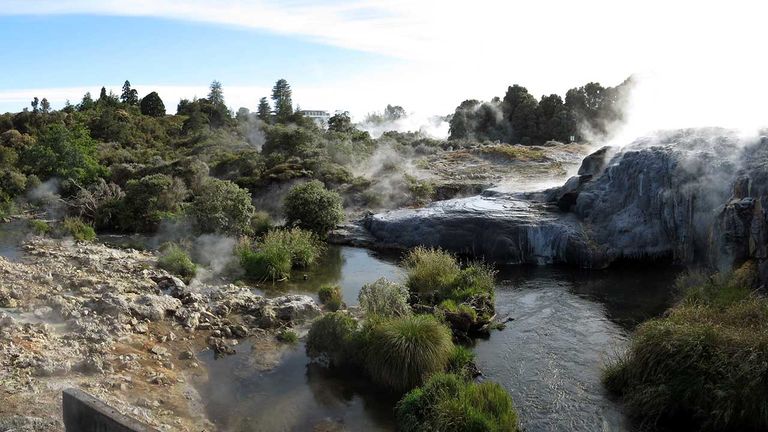 Mud pits and geysers make Te Puia in the Rotorua region appear otherworldly.
Credit: 2018 Creative Commons user boblinsdellThe indigenous Maori people tell tales of nearby Mount Tarawera, which fiercely erupted in 1886, devastating ancestral remains that traditionally were interned around its base. Today, the giant sleeps once more, and the Maori tribe runs daily walking experiences throughout the otherworldly landscape with Kaitiaki Adventures.
www.kaitiaki.co.nz
