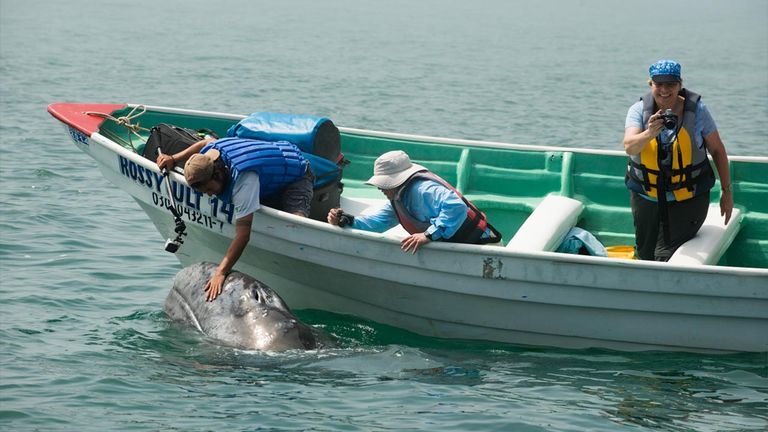
We petted a wild whale, my four tour mates and I. Hanging precariously over the side of the seaward-tilting fishing panga (a modest-sized, open boat), we splashed the sun-warmed waters of Mexico’s protected Magdalena Bay just off Baja California Sur’s Pacific coast. The splashes, we hoped, would draw the attention of the gray whale mother and calf from the nearby boat, whose passengers they were favoring as their petting zoo.
The curious baby, about a month to six weeks old, daringly left its mom’s side to sidle up alongside our boat. I held my breath, praying the calf would stay. With smiles lighting their faces, each passenger reached down and stroked the little one. Leaning over the higher bow, I could not reach before the errant calf returned to its mother.
Silently I pleaded for another chance. Minutes later, the elder leviathan obliged, propelling her enormous barnacle-encrusted head, ramrod straight, out of the sea behind the stern of the boat. One jet-black eye surveyed us, a picture-perfect snapshot I was too startled to take.
She sunk soundlessly back into the depths before drawing parallel to the panga, her calf nestled along her far side. As I ran my hand across her rubbery, white-spotted back, I was so overcome that tears trickled from my eyes.
Each winter, thousands of eastern North Pacific gray whales migrate more than 5,000 miles from Alaska’s Bering Sea to three protected Baja lagoons to give birth or mate from mid-January through mid-March. Nowhere else in the world do inquisitive mothers and calves approach skiffs and allow delighted humans to pet them.
While most visitors spend two hours watching the whales’ playful antics, we had the rare privilege of three days in the bay with Sea Kayak Adventures, which has a coveted permit to erect a self-sustaining seasonal base camp on uninhabited Santo Domingo, one of the barrier islands that shelter the lagoon from the open ocean.
 Thousands of eastern North Pacific gray whales spend the winter in Baja lagoons.
Credit: 2020 Chad CaseIt is the only company with a long-term concession in Magdalena Bay, as well as the only to offer a trip that combines a whale camp with kayaking the Sea of Cortez, the body of water that frames the eastern shore of the Baja California peninsula. Called the 3x3 Kayak & Whale Watching Combo, it is a six-day, all-inclusive, small-group itinerary (maximum 13 passengers) in the tour operator’s portfolio of Baja Tours.
The itinerary includes four boat trips (whale sightings guaranteed) and activities such as birdwatching, a guided nature hike across pillowy sand dunes, strolls on silken beaches and whale pep talks in the domed library tent, presented by marine biologist Mario Escalera. He served as trip leader for our group of eleven 40- to 70-somethings from the U.S., Canada and England and was assisted by two more local guides, a cook and panga drivers.
In the evenings, happy hour was followed by dinners featuring fresh-caught fish and Mexican specialties. Night brought blazing campfires and stargazing, unpolluted by a single light. Nestled on my cozy cot in our roomy wall tent mere feet from the sea, each time I awoke I heard the unmistakable sound of whales spouting, right outside our canvas shelter.
RELATED: A Luxury Camping Experience on Mexico's Sea of Cortez
The grays are just one of the migrant and resident species in the whale-rich waters lapping both sides of Baja’s peninsula. We were eager to see more.
An easy two-hour highway drive east across the desert and over the Sierra de la Giganta mountains delivered us to historic Loreto, the 323-year-old first capital of the Californias, midway along the peninsula’s east coast. Early the next morning, we shuttled about a half-hour south to a beach near Puerto Escondido, our point of entry for the kayak touring half of our expedition.
After a paddling lesson, we piled into tandem sea kayaks to gently propel ourselves a few miles each day while exploring the wonders of Loreto Bay, Mexico’s largest national marine park and a UNESCO World Heritage site. Proclaimed “the world’s aquarium” by Jacques Cousteau, the nutrient-rich Sea of Cortez supports the world’s largest and most varied whale population, including blue whales, for whom the sheltered waters are a winter nursery.
On day one, we pointed our bows for Danzante Island, one of five uninhabited isles in the park, where we camped in dome tents all alone on a white-sand beach. The second day, we paddled further east toward the rugged, stark cliffs of Isla Carmen, the largest isle. Pods of common dolphins, sea lions and pelicans entertained us and, once it was dark, so did the twinkling bioluminescence that lit the sea like underwater fireflies.
Thankfully, no mega-whales rose from the inky depths beside our teeny kayaks, but we were delighted to see them once we were safely perched in a panga, capping off a trip full of magical wildlife highs.
Departures of the 3x3 Kayak & Whale Watching Combo are available Jan. 17 to March 7 for 2021 (the two segments can be sold separately), with additional Baja itineraries on offer from November 2020 to May 2021). Custom private trips are also available.
The Details
Sea Kayak Adventures
www.seakayakadventures.com
