One week from the scheduled restart for Hawaii’s tourism industry, Aloha State officials continue to debate safety protocols for arriving visitors, and mayors for at least two of the destination’s neighbor islands are saying they want additional COVID-19 testing for travelers.
Hawaii Governor David Ige said Wednesday none of the state’s four county mayors had opted out of his pretesting plan for trans-Pacific visitors to the islands, but discussions with the leaders of Maui County, Oahu, Kauai and Hawaii Island were ongoing.
“I heard the concerns from all of the mayors,” Ige said during a Wednesday press conference, held in the Hawaiian Airlines terminal at Honolulu International Airport. “We all know that bringing back trans-Pacific travelers is essential to reviving our economy, and we are all committed to finding the safest way to do that. And, certainly, should it be that all the counties opt out, then we’ll have to look at other opportunities for bringing trans-Pacific travelers back.”
On Tuesday, Hawaii County Mayor Harry Kim said he wants to establish a post-travel test requirement for Hawaii Island visitors in addition to Ige’s proposed pretest plan, which is slated to launch Oct. 15.
“I just don’t think we should take the risk with one COVID-19 test taken up to three days before traveling,” Kim said in a statement. “There are so many variables involved in a pre-travel test that could make the tests unreliable. We have to have a second test upon arrival in Hawaii.”
There are so many variables involved in a pre-travel test that could make the tests unreliable. We have to have a second test upon arrival in Hawaii.
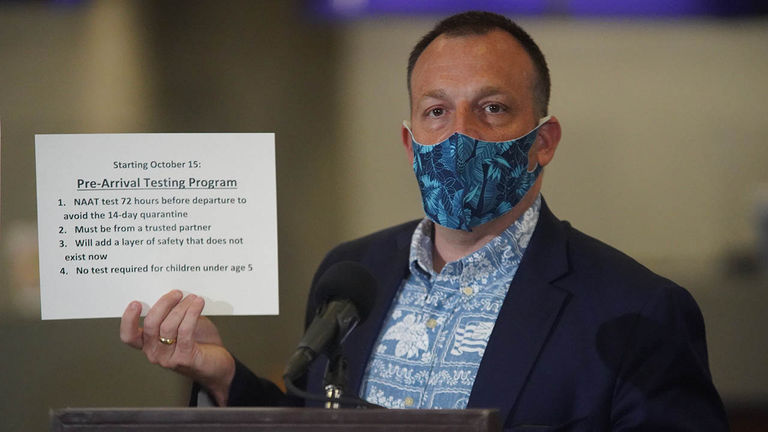
Ige’s pretest plan for trans-Pacific travelers would allow visitors with proof of a negative COVID-19 test — taken no longer than 72 hours before departure — to bypass the state’s current mandatory 14-day quarantine.
The Hawaii governor has postponed the start of that pretest approach three times already this summer. Earlier this week, concern mounted as calls from a number of elected Hawaii officials for a post-travel COVID-19 test threatened to again delay the destination’s tourism industry reboot.
Despite his comments about considering other options if the county mayors opt out, Ige did say on Wednesday, “I’m confident that we’ll launch a program on Oct. 15.”
“And we are committed to continually improving the program as we move forward,” he added.
Kauai Mayor Derek Kawakami said in a statement Wednesday that his administration had not yet decided about whether the Garden Isle will opt out of the governor’s pretesting plan.
“We need more details on what an ‘opt out’ means for the counties, and whether that provides the option for us to implement a single-test post-arrival program,” Kawakami said.
Late last month, Kawakami proposed a plan requiring post-arrival testing for all incoming travelers to Kauai intended to work in conjunction with the governor’s pretest plan. That proposal was denied by the governor on Monday, according to Kawakami.
“Our county administration has been clear that a single pre-arrival testing program alone does not provide the needed level of protection for our Kauai community,” Kawakami said.
During a Honolulu press conference last week, Hawaii Lieutenant Governor Josh Green said he anticipates the state will welcome between 5,000 and 8,000 visitors per day under the proposed pretest plan. A former emergency room physician heading the Ige administration’s pretest planning effort, Green indicated last week those arrivals estimates would make enacting a second test for Hawaii visitors difficult because the state only has the capacity to test 4,000 people per day, including its residents.
 Hawaii Lieutenant Governor Josh Green, who tested positive for COVID-19 last month, discusses details of the destination’s pretest plan for trans-Pacific visitors.
Credit: 2020 Hawaii Governor David Ige“If we mandated a second test four days after arrival, [or] three days after arrival, all 8,000 of those individuals would have to get a test,” Green said last week. “That would exceed our capacity, starting after the fourth day of our program, by 100%.”
Green also indicated state officials cannot officially require U.S. travelers to take a test before or after they travel to Hawaii.
“Logistically, [it’s] very hard to convince people to go get a second test because you’re not allowed to legally require a test,” he said last week. “What you can legally require people to do is go into quarantine.”
On Wednesday, Ige clarified his own worries about a post-arrival exam program’s impact on Hawaii’s test supply.
“As I’ve told the mayors, I’m just very concerned about diverting the testing capacity of the state from our local residents — for people who are symptomatic or people who have been exposed,” he said. “I don’t want them to be in a situation where a visitor and a guest gets a test, and our residents are unable to get the test that they need.”
I don’t want them to be in a situation where a visitor and a guest gets a test, and our residents are unable to get the test that they need.
Keith Vieira, a former Starwood Hawaii executive who is a principal at Honolulu-based hospitality consulting firm KV & Associates, said Wednesday Hawaii tourism stakeholders know there is pent-up demand for the destination. And while the industry is uncertain about exactly what that will mean in terms of daily arrivals figures starting Oct. 15, mixed messaging from state officials about what is required to avoid the 14-day quarantine during a visit is damaging.
“What travelers can’t ever take is uncertainty,” Vieira said Wednesday. “You’ve got to be able to make it a simple explanation of what’s going on. ... If each island is going to have their own set of rules relative to bypassing the quarantine, how could you ever figure that out?”
What travelers can’t ever take is uncertainty.
Lt. Gov. Green, meanwhile, also took part in Wednesday’s press conference at the airport, outlining a range of current specifics about the Aloha State’s pretesting program. Hawaii will require visitors looking to avoid the two-week quarantine to provide proof of a negative nucleic acid amplification test (NAT) at least 72 hours before departure on the final leg of flights to the islands, Green said. That test must be completed by one of the state’s partners, a collection of providers that now includes CVS, Walgreens and Kaiser Permanente as well as preflight testing options announced recently by airlines such as Hawaiian, United, Alaska and American. Results of the test will then need to be uploaded on Hawaii’s Safe Travels platform, which features a range of additional information about arrival requirements and safety protocols.
Green noted children under the age of 5 will not need to be tested and also announced what he described as an additional surveillance testing program, which would test about 10% of visitors and residents after they arrive in the islands. Although he said many details still need to be clarified, Green indicated that the program was largely meant to provide state health officials with further information about just how effective the governor’s pretesting plan is.
“If we do it as a study — which is a scientifically based approach, randomized and blind — it will just become data for the department of health,” he said, noting officials are considering gift cards as incentives for visitors to take the volunteer COVID-19 tests. “This will not be meant to weed out additional people and then put them into quarantine.”
For Anneke Marchese, a Hawaii specialist and owner of AM/FM Leisure & Adventure Travel in Bend, Ore., lingering ambiguity about what’s required to visit Hawaii without a quarantine and the lack of information about what clients should expect once they arrive has been terrifically frustrating.
Marchese, who has fielded some recent calls from clients about Hawaii, said the only person she felt comfortable booking to the islands before the beginning of next year was herself, noting, “I want to know what it looks like, so I can warn my clients.”
Still unclear about the details over her own trip — tentatively slated for December — Marchese said booking a Hawaii vacation for clients before 2021 just doesn’t make much sense.
“The idea of telling other people to join in on this crazy train — when I don’t even know what my own travel is going to look like in December — is really discouraging,” she said.
The Details
Hawaii State Department of Health
www.hawaiicovid19.com
