If you ever happen to be wandering in downtown Pachuca, Mexico, don’t be surprised when the usual urban cacophony is interrupted by something a bit foreign: the resounding chimes of a 132-foot clock tower that looks and sounds like it was transplanted from England.
The Reloj Monumental de Pachuca (Monumental Clock of Pachuca), in a way, is just that: an architectural and cultural transplant, as well as a unique symbol of the long-standing ties between England and this part of Mexico. Starting in the early 1800s, thousands of Cornish miners and their families emigrated from Cornwall to Pachuca — the capital of the Mexican state of Hidalgo — and the nearby town of Real del Monte to find work in the region’s booming gold and silver mining industry. The mining has long since dwindled, but the cultural ties are still visible today, in everything from architecture and cuisine to sports.
The neoclassical clock tower, built between 1904 and 1910 on a grand plaza to commemorate the centennial of Mexico’s independence, was funded by Francis Rule, a Cornish immigrant who made his fortune through mining in Mexico. The tower houses a small gift shop, and tours are available that take visitors to the observation level.
Just a few blocks away, the beautiful Casa Rule (Rule House) was built in 1896 to serve a dual role as Rule’s home and his company headquarters. It has housed government offices since 1985, but the general public is allowed to enter the building and also view the small, street-level windows that his company used to pay miners.
Rule also financed the construction of Iglesia Metodista del Divino Salvador (Methodist Church of the Divine Savior) — which was inaugurated in 1901 — largely to serve the religious needs of Cornish miners and their families. Also worth a visit is Museo de Mineria (Mining Museum), which is set in an ornate 19th-century building that was originally the headquarters for another mining company.
Pachuca’s English connections are also celebrated at a much newer attraction: Salon de la Fama del Futbol Internacional (International Soccer Hall of Fame), which is housed in an eye-catching, 125-foot structure designed to represent a giant soccer ball. Many believe that soccer was first introduced in Mexico by immigrants from Cornwall, and it has since become the nation’s most popular sport.
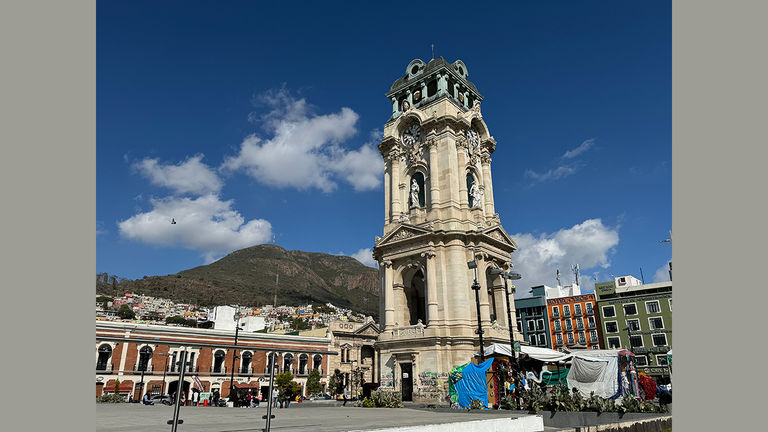 A 132-foot clock tour is in downtown Pachuca, Mexico, within the Mexican state of Hildago.
Credit: 2024 @departure_level
Other modern attractions in Pachuca include Mural de Palmitas, a massive mural created by a group of artists on the sides of houses in a hilltop neighborhood. And in La Parroquia de la Asuncion de Maria (Parish of the Assumption of Mary), which dates to the 1500s and is Hidalgo’s oldest church, visitors can view a strikingly contemporary work of art: Mural de los Angeles (Mural of the Angels), a work by local artist Jesus Becerril Martinez that features muscular nude angels and a spaceship flying through a vibrant outer-space backdrop. The work was so controversial when Becerril started it in the 1970s that its completion was temporarily suspended.
Another must-see for culture and art lovers in Pachuca is Museo Cuartel del Arte, a cultural center housed inside a former 16th-century convent that features multiple exhibition and performance venues. I especially enjoyed a walk through Museo de la Fotografia (Museum of Photography), which has an extensive collection of historic images from a 170-year span.
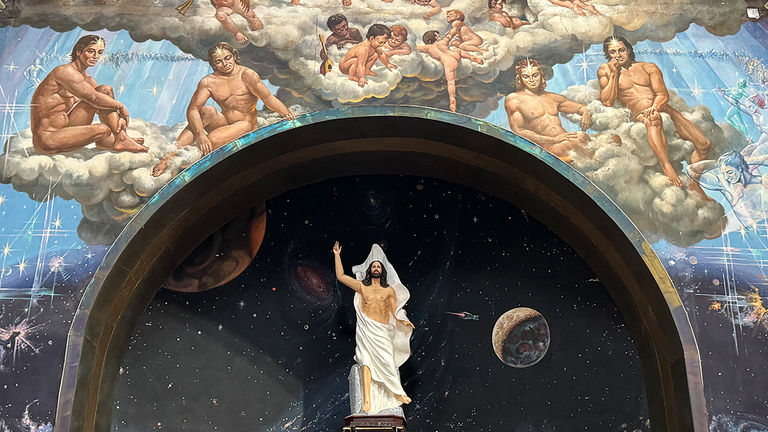 A mural by Jesus Becerrill Martinez at La Parroquia de la Asuncion de Maria
Credit: 2024 @departure_levelSide Trip to Real del Monte
No history-focused visit to Hidalgo would be complete without a side trip to Real del Monte (also called Mineral del Monte), a designated Magical Town where veins of minerals were first discovered in the 1500s. Today, the mines that brought wealth to this region — and attracted thousands of Cornish miners — are museums where visitors can learn about the history and process of mining for gold and silver.
Book lovers may also recognize Real del Monte as the inspiration for the setting of the book “Mexican Gothic” by Silvia Moreno-Garcia; the novel is reportedly now in development to become a limited series, which may bring even more attention to this lovely town.
Mining museums now open to the public include Museo de Sitio y Centro de Interpretacion Mina La Dificultad (La Dificultad Mine Site Museum and Interpretation Center) and Museo de Sitio Mina de Acosta (Acosta Mine Site Museum).
The Panteon Ingles (English Cemetery) is another visual tribute to the town’s diverse heritage. Perched dramatically on a hilltop overlooking the town, it’s the final resting place of dozens of English immigrants and others involved in the mining industry. Also interesting is Museo de Medicina Laboral (Occupational Medicine Museum), which is set in a former hospital that served miners.
Foodies, meanwhile, won’t want to miss Museo del Paste (Pasty Museum), which is dedicated to yet another tradition brought from across the ocean: pastes (or pasties), tasty, empanada-like treats that can be filled with a variety of meats and vegetables.
How to Get There and Where to Stay
The city of Pachuca is less than two hours by car or bus from Mexico City (although it’s a good idea to time the trip to avoid peak rush hours). It’s even closer to Felipe Angeles International Airport, the new airport that serves Mexico City.
Uber and other ride-share apps do not operate in Pachuca or Real del Monte, but taxis are plentiful, and rates are reasonable. An inexpensive “combi” bus line connects Pachuca with Real del Monte for 13 pesos, while the 20-minute trip by taxi costs more than 100 pesos (I took a taxi to get there, and a combi back, and found them both efficient). Taking a taxi provides the opportunity to stop for photos at a 108-foot statue of Jesus Christ that presides over a hilltop next to the highway.
There are internationally branded hotels in Pachuca, but not in the historic city center. I stayed at Capitalino Hotel y Plaza, a recently rebranded hotel that features attractive decor and a central location for exploring downtown. I appreciated the photo-worthy view of the clock tower from my king room (just be prepared for the chimes, which ring multiple times every day). A la carte breakfast is included with most room rates.
