Do you have clients who are debating between a river cruise in the U.S. or a sailing in Europe? Besides the obvious differences in destination, there are a number of other details that may sway travelers one way or the other.
A top consideration will surely be how the vessels on the Mississippi, Columbia and Snake rivers in the United States, for example, differ from those on the Danube, Main and Rhine rivers in Europe.
Here’s a sense of what passengers should know — and expect — when deciding where to cruise.
Comparing Ship Size
The most dramatic contrast between domestic and European river cruising is the size of the ships that navigate the respective rivers, and that variance is mainly due to the locks and bridges of Europe.
With the exception of double-wide vessels such as AmaWaterways’ AmaMagna, which is capable of navigating only a portion of the Danube, most European vessels are limited by long, narrow canal passages via ascending and descending locks and short bridge clearances.
The result of those limitations has resulted in riverboats that are built in limousine-like proportions (not exceeding 450 feet in length, and 40 feet in width), with Viking’s Longships serving as a prime example. Typically, European riverboats are quadruple-decker boats (with the first level partially below the waterline), with a lounge and restaurant positioned at the bow and staterooms and suites divided by a single hallway toward the stern. Vessel capacities usually top off at around 200 passengers.
Some boats are limited even further on waterways like the Douro and Seine rivers, where they must be smaller still.
Stateside, a river like the mighty Mississippi is not so confining. Domestic waterways have their own locks and bridges to contend with, yes, but they are not nearly as prohibitive.
Most recently, I sailed on the Viking Mississippi, and while its 471-foot length is comparable to its cousins in Europe, its 75-foot width and its five decks (all above the waterline) certainly exceed the size of any riverboat in Europe. This allows for not only a near doubling of the passenger count, but also expanded private cabins, making them closer in size to those on ocean cruise ships. These vessels will have several more public venues onboard, as well.
Comparing Vessel Passenger Counts and Crowds
Another variance is how many more passenger vessels traverse European waterways vs. domestic rivers. Hundreds of riverboats navigate Europe’s main rivers and beyond, whereas only dozens operate in the U.S., and this makes for a huge difference in experiencing a destination.
While only one riverboat per port is common domestically, there may be multiple vessels docked per berth (and multiple berths, per port) abroad. It is not uncommon to see two or more matching-sized riverboats double, triple or quadruple up, tied together at one docking location. This then requires guests to sometimes pass through or above other ships on their way on or off the ship.
Then, once on land, the number of docked riverboats can translate to greater crowds touring around. Domestic ports are always the opposite: very quiet, and free of congestion.
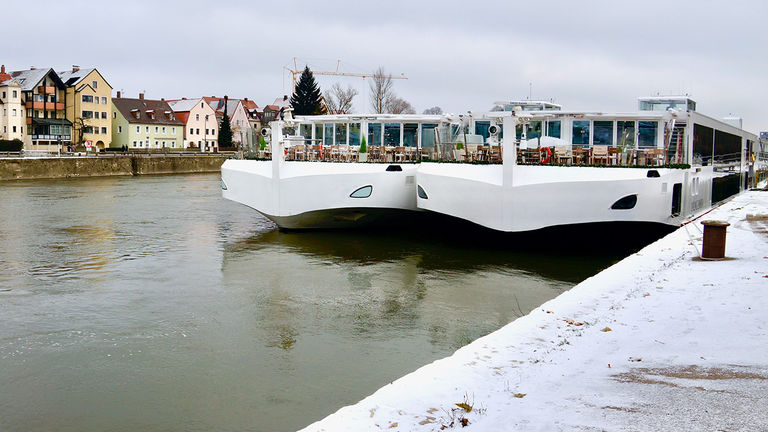 It's not uncommon to see multiple riverboats docked alongside each other in Europe.
Credit: 2024 Jason LeppertOther Details to Keep in Mind: Seasonality and Shifting Water Levels
European rivers with certain operable windows of time may be crowded with boats, while January and February are usually considered the off-season, when the vessels are temporarily laid up. In the U.S., the Columbia River can be similarly seasonal, but the Mississippi River is used nearly year-round.
Water levels are another consideration. When levels are too high, bridge clearances are lower, and when water levels are too low, some vessels cannot sail. That’s why a shallow vessel draft and propulsion type is so important. Traditionally, fluctuating water levels made paddle wheelers, which just skim the surface, superior to vessels with propellers well below the waterline. Many paddle wheelers still navigate U.S. rivers, making for a more old-fashioned vessel aesthetic and onboard experience.
The aforementioned Viking Mississippi, and several riverboats from American Cruise Lines, are contemporary exceptions. But in general, the vessels operating in Europe are more modern, at least in overall style.
Finally, a client considering the two river cruise destinations will surely think of proximity to home. There’s simply no denying the convenience of sailing closer to home, especially if all the trip entails is driving to the embarkation port.
