Although I was born and raised in urban Honolulu, I’m a “country girl” at heart. I would much rather be amid the quiet majesty of mountains and forests than the hustle and bustle of the concrete jungle. So, my excursion to Kahuku Farms on Oahu’s rural North Shore was a welcome break.
Here’s what travel advisors might share with clients interested in a similar respite while visiting Oahu.
Kahuku Farms History
Kylie Matsuda-Lum, managing director of the farm, shared that her paternal great-grandfather came to Oahu from Fukuoka, Japan, at the turn of the last century. He began growing pineapple as an independent contractor in Kahuku, while working full time as the irrigation supervisor for Kahuku Sugar Plantation. Her grandfather grew bananas, papayas, sweet potatoes, bell peppers and watermelons on the side, and her dad continued the tradition, growing papaya and apple banana for 50 years.
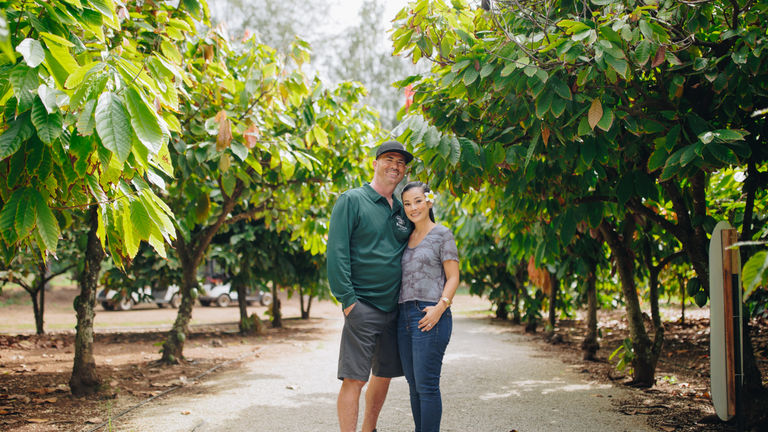 Kylie Matsuda-Lum and Judah Lum of Kahuku Farms
Credit: 2025 Kahuku FarmsToday, Matsuda-Lum handles marketing, public relations, product development and special events for the five-acre attraction. Her sister, Kalyn, is the food-and-beverage director, her husband Judah is the director of operations overseeing the gardens and tour department and her semi-retired father, Melvin, supplies the on-site café with tangerines, mangoes and avocadoes from his five-acre orchard.
 The farm’s cafe serves dishes made with fresh fruits and veggies harvested from the grounds.
Credit: 2025 Kahuku FarmsWhat to Expect at the Farm, From Tours to Farm-to-Table Eats
Kahuku Farms doesn’t charge admission, making it great for families. There’s even an expansive lawn where kids can play with provided balls while adults relax in the shade of neem and hau trees. Dozens of fruit trees flourish in the adjacent garden, delighting visitors of all ages.
The epitome of farm-to-table goodness, the farm’s cafe serves pizza, salads, sandwiches, soups and smoothies made with fresh fruits and veggies harvested from Kahuku Farms and its parent company, 140-acre Matsuda-Fukuyama Farms. Souvenir hunters will love browsing in the Cocoa House, which sells edibles, bags, hats, shirts, doggie treats and bath and beauty products along with delicious coffee and tea drinks.
I snagged a seat on the 90-minute Grand Wagon Tour (there’s a fee for this) and was glad I did — it added depth to my visit. A tip: book online a month in advance, as it’s only offered once a day (sometimes twice if that fills up) and frequently sells out. A tractor-pulled wagon takes a maximum of 24 visitors through about 30 acres of fields and orchards in production, with ample samples offered at every stop.
 Educational tours, such as the 90-minute Grand Wagon Tour, should be booked in advance.
Credit: 2025 Kahuku FarmsOur guide, Judah Lum, began by summarizing the Matsuda family’s four-generation history in farming and the challenges local farmers face. While farming in Hawaii may seem easy because the weather is generally beautiful year-round, he explained that this is not the case.
“For one thing, 85-90% of Hawaii’s food is imported,” Lum said. “Bugs such as mites, aphids, thrips, whiteflies and beetles hitchhike here, and they don’t die from natural eradication like they do on the continent from freezing temperatures. They multiply continuously, and although it’s expensive, it’s very important to manage that situation.”
He also pointed out that Hawaii’s high humidity creates ideal growing conditions for mold and fungi, which can rot roots and fruit. Moreover, crops can be damaged if they’re not protected from brisk winds, and weeds must be controlled, so they don’t compete for nutrients.
“Along with growing food, you’ve got to sell it if you want to stay in business,” Lum said. “It’s very difficult to grow healthy crops all year long, and it's just as difficult to sell them for a profit. Wholesale buyers want quality products — the right color, size and shape. They want large quantities at a good price. And they want consistency every week of every month, 12 months a year. If you fail in just one of those areas — quality, quantity and consistency — they can always work with someone else.”
Add floods, drought, storms and other natural disasters to the equation, and I realized I had been taking the produce I buy at grocery stores and farmers markets for granted. Farmers are rock stars.
Throughout the tour, Lum shared fascinating facts. During the stop in the banana grove, we learned that a banana plant yields only one bunch of fruit in its two-year lifetime (I researched this further and found out that a bunch comprises about 50 to 150 fruit). Although the “mother plant” is cut down after harvesting, more can grow by replanting the shoots at its base.
At the papaya field, Lum explained that the tree-like plant comes in three sexes — male, female and hermaphrodite — that are identified by the shape of its flowers.
“Male plants never produce fruit, so we don’t keep those,” Lum said. “Female plants produce fruit that’s asymmetrical, filled with seeds and not always tasty. If such papaya comes from a plant you have at home, it’s fine to eat but not suitable for our brand, so we remove the females too. We only keep the hermaphrodite plants because they are self-pollinating and bear fruit that has great flavor and a nice symmetrical shape."
In the cacao orchard, we learned that Hawaii is the only state in the U.S. where cacao can be grown commercially. Thanks to its warm climate and high humidity. The Aloha State’s location about 20 degrees north of the equator puts it at the outer (coolest) boundary of the cacao-growing zone.
“We typically harvest cacao pods from February through May and again from October through December,” Lum said. “But seasons can change; this year, our trees still had pods in July that were picked during our tours.”
Come hang out with us and nature. Learn how fruits and vegetables are grown, enjoy our farm-inspired food and experience stress-free, slow-paced country living.
He cracked open a few pods and invited us to taste the white pulp surrounding the beans, which transforms into the world’s favorite treat: chocolate. Fruity and a bit tart, it was interesting — but I much preferred Kahuku Farms’ dark and milk chocolate, which are sold in bars at the Cocoa House.
In short, the educational tour, laid-back setting and warm hospitality of the Matsudas and their ohana (family) of employees make this North Shore diversion a must.
“Come hang out with us and nature,” Lum said. “Learn how fruits and vegetables are grown, enjoy our farm-inspired food and experience stress-free, slow-paced country living. There are always good vibes here at Kahuku Farms.”
